
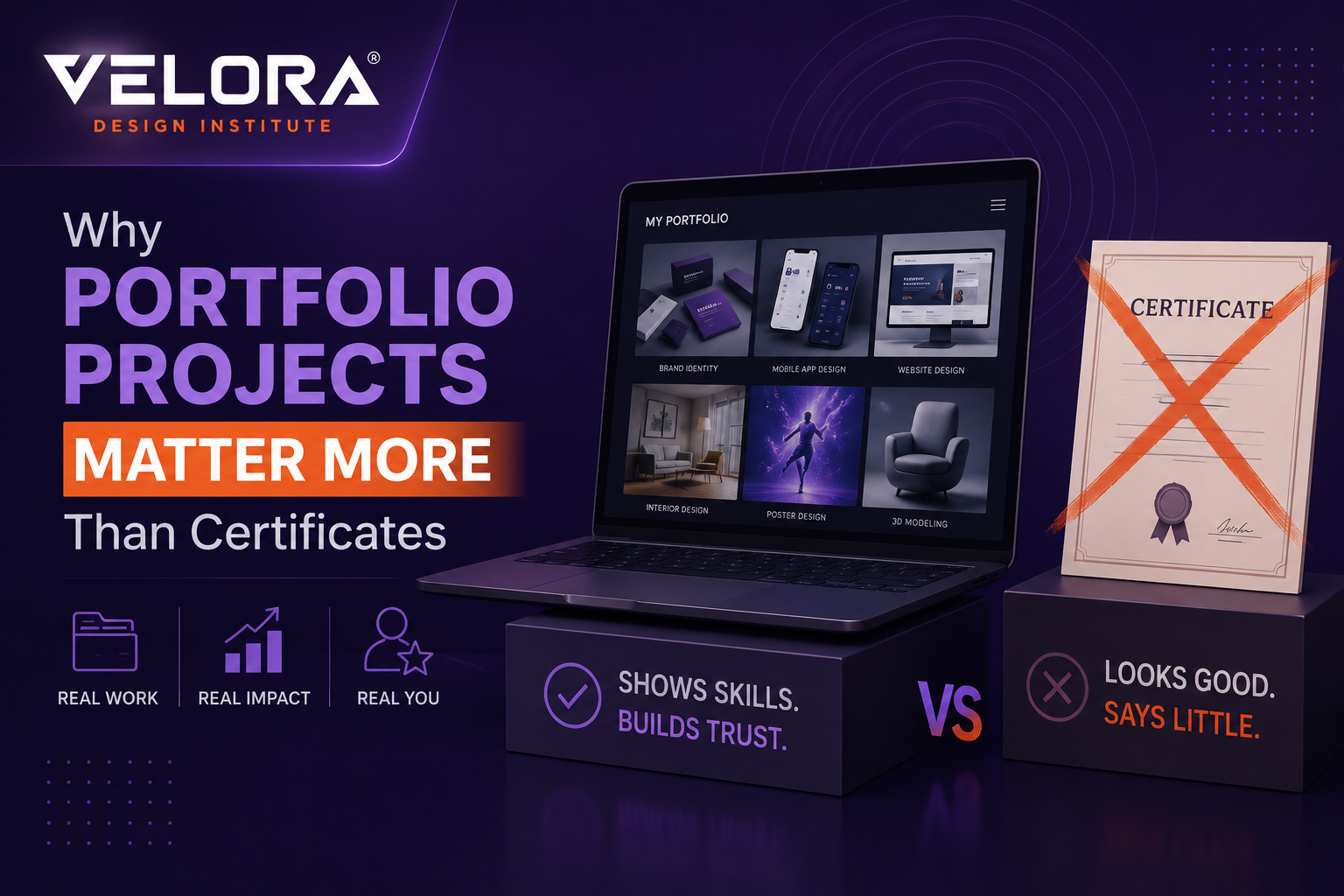
Why Portfolio Projects Matter More Than Certificates
July 22, 2026
Why Portfolio Projects Matter More Than Certificates
When applying for a design job, one question matters more than any certificate you hold:
"Can you show us your work?"
In the creative industry, employers don't just evaluate qualifications—they evaluate skills. A well-crafted portfolio demonstrates your creativity, problem-solving ability, technical expertise, and design thinking far better than a certificate alone.
At Velora India, we believe that real-world projects are the foundation of successful design careers. While certificates validate your learning, a strong portfolio proves what you can achieve.
Why Certificates Alone Aren't Enough
Certificates show that you've completed a course, but they don't always reflect your practical abilities.
Recruiters often look beyond qualifications to understand:
- How you approach design challenges
- Your creativity and originality
- Your understanding of design principles
- Your ability to communicate ideas visually
A portfolio answers these questions by showcasing your actual work.
What Is a Design Portfolio?
A portfolio is a collection of projects that highlights your skills, creativity, and growth as a designer.
It can include:
- Logo and branding designs
- Social media creatives
- Posters and brochures
- UI/UX concepts
- Packaging designs
- CAD drawings and 3D models
- Interior or architectural visualizations
- Personal creative projects
Each project tells a story about how you think, solve problems, and apply your knowledge.
Why Employers Prioritize Portfolio Projects
Demonstrates Practical Skills
Anyone can earn a certificate, but creating high-quality projects requires applying design principles to real-world scenarios.
A portfolio allows employers to evaluate your technical skills and creative approach.
Reflects Your Creativity
Every designer has a unique style. Portfolio projects showcase your originality, attention to detail, and ability to develop ideas that stand out.
Builds Professional Confidence
Working on projects helps students gain hands-on experience and prepares them to handle client requirements with confidence.
Makes Interviews More Engaging
Instead of simply discussing your skills, you can explain the challenges you faced, the design decisions you made, and the results you achieved.
Quality Matters More Than Quantity
A portfolio doesn't need dozens of projects.
Five to ten well-executed projects that demonstrate creativity and problem-solving are often more valuable than a large collection of average work.
Focus on projects that show:
- Creative thinking
- Strong design fundamentals
- Consistency
- Attention to detail
- Practical application
Build a Portfolio While You Learn
The best time to start your portfolio is during your training.
Students should regularly work on:
- Brand identity concepts
- Marketing materials
- UI mockups
- Product packaging
- CAD drafting projects
- Interior layouts
- Personal creative challenges
Each completed project strengthens your portfolio and prepares you for future opportunities.
Learn Through Real Projects at Velora India
At Velora India, students are encouraged to learn through practical assignments rather than relying only on theory.
Our Graphic Designing Course in Madurai emphasizes:
- Hands-on design projects
- Industry-standard software
- Portfolio development
- Creative problem-solving
- Feedback from experienced trainers
This practical approach helps students graduate with both the skills and confidence needed to enter the creative industry.
Portfolio + Certificate = Career Success
Certificates remain valuable because they demonstrate your commitment to learning.
However, when combined with a strong portfolio, they become even more powerful.
A certificate tells employers where you learned.
A portfolio shows them what you can do.
Together, they create a strong first impression and improve your chances of securing internships, freelance projects, and full-time design roles.
Conclusion
In today's competitive design industry, practical experience speaks louder than qualifications alone. Employers want designers who can think creatively, solve problems, and showcase their abilities through real projects.
At Velora India, we help students build industry-ready portfolios alongside technical knowledge, ensuring they graduate with the confidence to pursue rewarding creative careers. If you're looking for a Graphic Designing Course in Madurai, choose a program that values practical learning as much as certification—because your portfolio is often your strongest introduction.
Frequently Asked Questions
1. Why is a portfolio important for graphic designers?
A portfolio showcases your practical skills, creativity, and completed projects, helping employers assess your capabilities beyond academic qualifications.
2. Are certificates still valuable?
Yes. Certificates validate your learning, but a portfolio demonstrates how effectively you can apply that knowledge in real-world situations.
3. What should a beginner include in a design portfolio?
Beginners can include branding projects, posters, social media creatives, UI concepts, packaging designs, CAD models, and personal creative work that reflects their skills.
4. How many projects should a portfolio have?
A portfolio with 5–10 high-quality projects is generally more effective than one with a large number of average-quality designs.
5. Why choose Velora India for graphic design training?
Velora India combines practical projects, industry-standard software training, and portfolio development to help students become career-ready creative professionals.